Monday, 30 November 2009

Superbad Movie Trailer


In this movie trailer the director uses a wide range of different camera angles, shots and movements. This shows that the director must have put a lot of thought in how he wanted the scenes the look and what he wanted the audience to feel as they watched each selection of footage.
The first shot we see is a tracking shot to show the movement of what we understand to be a mother moving towards a car, this shows that this woman has a very dominant and secure walk and is in no sense of danger or feels threatened in any way. We follow this to over the shoulder shot of two boys in a car looking at the women, this shot shows the audience that the women is very comfortable with the boys and also gives us the opportunity to feel as if we are part of the conversation.

The conversation continues with a POV shot of the women looking at the two boys driving the car this means we can see the faces of the boys and their reaction to the conversation, giving the audience a chance to establish the relationship between the characters. A two people medium shot then comes up of the two boys in the car this lets the audience see the two boys together and how they interact with each other, with the medium shot we can see the body language of the two boys so the audience can see what type of relationship they have. We then cut to a long shot of the same two boys coming off a bus, this shows how the two characters feel in there surroundings and how that the two boys must be close friends as we see them in many different situations, the use of this particular camera angle lets the audience become more acquainted with the characters and see what they look like shoulder down.

Another over the shoulder shot is then used between two people to show that another conversation is taking place, this use of shot lets us see the peoples reactions very clearly and to understand how they feel at certain words or phrases being used the audience can relate to this and begin to understand what type of film they can expect. We then get the first use of camera movement with a panning shot showing three boys at a party and this lets us see how they behave in there free time and the audience feel like they can relate to how the kids behave and feel as if they are one of the people at the party with them. We then get a medium shot which the director would have used to show the feelings of the adults at the house and the slight low angle shot gives the audience a feeling of being looked down on by the parents and as if they are bigger and have more authority then we do. The camera then changes to a medium shot of three boys; this introduces another character to the audience and shows us that he is another character that is very close to the two kids we have seen before and could have a large influence in the film this is followed by a POV close up of what the boys were looking at, a director uses this to show important props that would not be remembered by the audience if it was not specifically pointed out with this type of camera angle, we then have an extreme close up of the same object to further highlight the faults in the object and so that the audience can really understand what the people are looking at.

We have a two person view of two policemen to show the audience what they look like and how close as a partnership they are. A panning shot of a police car is then used to make it feel even faster then it was going and as if it was in a chase or had to be somewhere very urgently. There is a large selection of high angle shots to show two boys in bed, this shot makes us feel powerful over them and that they are very vulnerable in the state and position they are in.
The trailer uses a lot of different camera angles which helps the audience establish what the characters are doing it and where there doing it, but there is a distinct lack of camera movement used by the director.

Monday, 23 November 2009

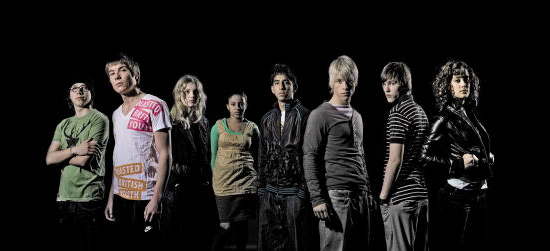
Skins Series 2 Episode 1 - Opening Scene (Disability Analysis)

The first scene of the episode opens with the characters performing a dance routine. The diegetic music they are dancing to is very up-beat drum and bass. This gives a very lively and powerful atmosphere, a complete contrast with Tony and his disability. The dancers themselves use very energetic and complex moves. This shows off their able bodies to the audience. While the dance routine is taking place there is a lot of fast cutting this adds to the speed and energy of the dance.

Once the routine is finished the audience is then introduced to Tony. He is represented completely differently to the other able bodied characters. The first time we see him he is sitting down, motionless in a dark corner of the room whereas all the other characters are shown under spotlights. This represents the dreadfulness of his disability in contrast to his able bodied friends. By showing Tony sitting down and Maxxie standing also shows that Maxxie has greater power and presence than Tony another way of portraying his disability to the viewer. The shot used is a high angle, over the shoulder shot which also shows that Maxxie is the more dominant character by making Tony seem small and insignificant. The main way in which Tony is represented as disabled is through his speech and interaction with other characters. When Maxxie asks him if he thought the dance routine was good Tony comes across as being completely oblivious to his surroundings and after Maxxie asks him for a second time he eventually responds with mumbled ok. This is a big clue to the audience that Tony does suffer a disability.

After Tony is introduced to the audience the non-diegetic backing music changes completely. No longer is it the upbeat drum and bass that was experienced at the beginning but slow, emotional music too fit in with Tony’s personality. The setting for the next part of the scene is on a bus. The camera shows a close up on Tony looking aimlessly out of the bus window. This again shows that he is oblivious to his surroundings, as though he is in a world of his own. The camera then cuts to a two shot showing both Tony and Maxxie. This shows the contrast between the unsettled Tony and the calm, relaxed Maxxie. The camera then cuts to a close up outside of the window of another bus going alongside the bus that Tony and Maxxie are in and a diegetic, amplified sound of a horn. This makes Tony jump once again showing that he is on edge. Maxxie tries to then settle him down and whilst he is doing this again the camera goes to a close up of Tony holding Maxxie’s hand. This is a sign of insecurity showing the Tonys fragile mind.

Tonys disability is confirmed when him and Maxxie meet the group of young girls. One of the group asks him ‘are you mental?’ too which Tony replies ‘yes’.

The next setting for the opening of the episode is at Maxxie's house. Here the audience learn even more about how Tony’s disability affects him and some of what he used to be like before the accident that caused it. The first thing we see in this scene is an establishing shot of Maxxie’s dining room. Surrounding it are many rosettes and trophies for dancing.

This shows that Maxxie’s able body is superior to Tony’s disabled body. During the scene Maxxie’s Mum starts a conversation with Tony. She speaks to him differently to how she would speak to her son. She uses very simple language and asks him simple questions that only require one word answers. This fits in with the typical stereotype of people interacting with disabled people and how they treat them differently to that of someone able bodied. Maxxie’s mum asks Tony a lot of questions about how he is until eventually he just says ‘I don’t remember you’. This shows too the audience the extent of his mental illness. After the awkward conversation ended Maxxie’s Mum brings out dinner for the two. Maxxie then has too cut up Tony’s food for him and when he is eating it his Mum has to wipe Tony’s mouth for him. This fits another stereotype that disabled people cannot care for themselves. Whilst Tony is eating his food the audience can see that he struggles to hold the knife and fork showing that he also suffers a physical disability. The camera jump cuts to Tony’s Mum in his bathroom at home. Here we see that amenities have been modified to help Tony like hand rails and an alarm. This confirms that Tony has major physical disabilities to the viewer.

To conclude the makers of ‘Skins’ use plenty of clear techniques in order to represent disability to the audience. The use of stereotypes makes it very clear to the audience that Tony is disabled although his whole persona is not solely based around this stereotype.

By Matt Davison


The Dark Knight - Opening Scene (Camera Shot and Movement Analysis)


The opening a scene of ‘The Dark Knight’ uses different camera shots and movements in order to interpretate the film to the audience, and grip them from the start.


The Film opens with an establishing shot showing ‘Gotham City’. This tells the audience exactly where they are and where the film is being set. The camera then slowly zooms in on a window in one of the buildings. This immediately alerts the viewer that this window has significant importance and we a reassured of this when eventually the window smashes and the camera switches to close up revealing a mobster holding a gun and firing a grapple wire to another building. Showing this early on in the film tells the audience straight away what the film is about and what the film is likely to carry on in to later on.

The camera then skips to long shot of a man the camera then zooms in on the mask he is holding. Again this shows the importance of object and highlights this to the audience. He then gets into a car that pulls up alongside him. The film then cuts back to the original two mobsters in a two shot of both characters sliding along the grapple wire to the next building. The camera then tilts downwards revealing how high up the action taking place is. The camera then shows the viewer an aerial master shot of both the characters sliding along the wire and showing the city in the back ground. This shot again emphasises to the viewer the immense height of the characters and the use of the aerial shot shows the vulnerability of the characters.

The next camera shot shows three different mobsters in the car. Various camera shots are used to show the convosation they are having for example over the shoulder shots and mid shots but all keeping with in the guidelines of the 180 degrees rule.

The final part of the opening scene shows the mobsters getting out the car and running into a bank. As the mobsters move around the bank the camera follows them. Here a steady cam is used to get a good quality, smooth shot that can move where ever the characters go.

By Matt Davison

Tuesday, 17 November 2009

The ring, opening scene


This is a good opening scene because It gets the audience focused on the movie. The music is really good because it sets the tension within the set. The camera shots that are being used during this scene are close ups, medium shots and establishing shots like at the beginning.There are a few close ups to show the facial expression of the character, this is so that you can see how they are feeling at the exact point in time. They are using camera angles like a high so that the camera is looking down on the character to make them look small and scared.

The lighting in this scene is dark which is suggesting that the character is home alone worried. This is the prime place for an incident to happen. She is wearing her school uniform, black skirt and white shirt. This suggests that she has just got home from school and is wanting to sit in front of the T.V and relax, but this is not the case.

The sound has been used very well in this scene because they have used creepy music which creates tension and uncertainty. As the tension builds so does the sound, it gets louder and louder then suddenly stops. A Good example of this is when the T.V turns on automatically, as she runs towards it the music increases in volume but then suddenly stop as she pulls the cable out. This is done so that we know the tension is over for now. Otherwise during then scene it is very quiet suggesting that she is home alone.

This opening scene is a bit of a cliff hanger because just when you are about to find out who or what is in the bathroom the screen goes all fuzzy which shows us that it may come back to that clip later on in the scene.

By Chris Marskell


Scream Analysis


combination analysis

The very first clip of the film is of the word "scream" which is the title of the film, the font used is dark red which connotates blood. At the the same time we can hear amplified screams in the background which make the audience unsettled and worried about what is goin to happen in the next scene.

While drew is on the phone the tension is building within the scene, this is because she is feeling some uncertainty from the caller. While this is happening the popcorn is growning every second which can relate to the tension growing.

A combination of sound and Mise on scene was used quite frequently, the best one was when, the shot went outside the house. There was an amplified sound of the rope swinging from side to side which shows us that someone had just been sitting on it watching the house. This creates a sense of danger and scariness which keeps the audience on there toes. The sound is key to this clip because it make the whole clip seem so much more scarier.

The first sign that Drew gets is when the killer says "i want to know who I'm looking at" At the same time there is a loud bang which is an effect this is when Drew suddenly realises that she is in danger, it is like a penny dropping and she knows she is no longer safe. The camera quickly shifts to the left now looking outside but with drew still in the shot, this was so that the audience could see if someone was outside.

There is a clip outside in the garden where the camera starts at the top of a tree, we can her a rope swinging and crickets in the background which tells us we are in the middle of nowhere. The camera starts to tilt downwards slowly which makes us as the audience scared and wanting to know what is coming up. As the camera gradually gets to its end point there is no one on the seat which shows we have just missed them, the location is dark and gloomy therefore tells us something bad is going to happen.

The camera seems to zoom onto her face a couple of times, at the beginning of the scene she is all happy and relaxed, but as the scene progresses she becomes scared and her facial expressions become worried.

By Chris Marskell